TWO HUNDRED YEARS OF FIRST-CLASS CRICKET
Milestone Match Remembered
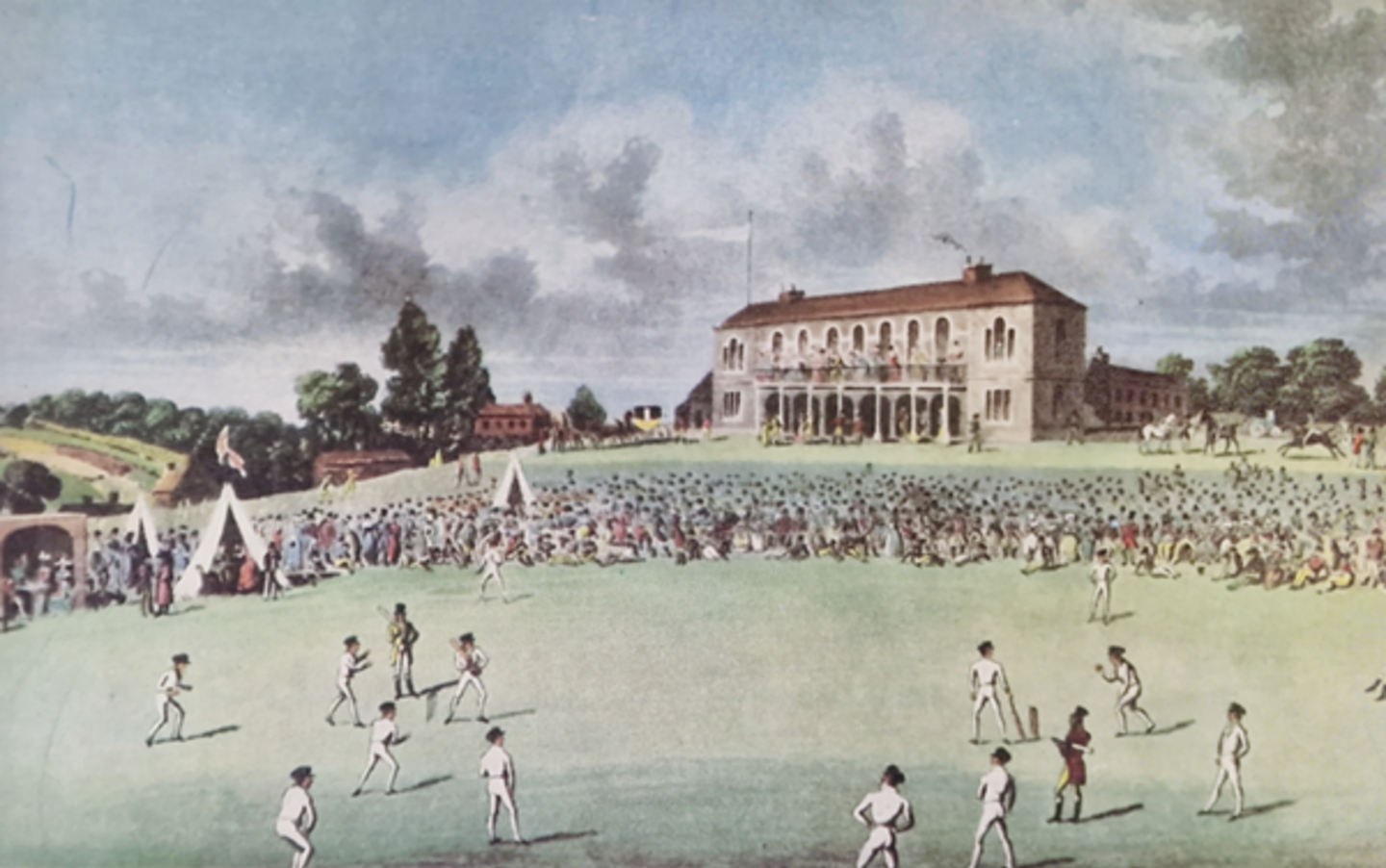
In 1826 eleven men from Nottingham Cricket Club travelled by carriage to Sheffield, for something of a repeat fixture, and yet, in historic terms, very much more.
The first recorded match by any Nottingham team was more than fifty years earlier, in 1771, against a Sheffield XI, played on The Forest. Over the next five decades the two clubs had met several times…a Nottingham XI had beaten a 15-man Sheffield team decisively in 1822 (twice), and a 14-man Leicester side by 100 runs in 1823.
On 24 July 1826, two hundred years ago today, a bigger challenge awaited: a fixture against 11 men from Sheffield (6 men) and Leicester (5 men) combined.
That game, played at the Darnall New Ground, Sheffield, in July, is recognised as the first First-Class match played by a Nottingham team.
Nottingham began as favourites. It would be good to report that Nottingham justified their position but in truth this was a mis-match, thanks to one man – Tom Marsden of Yorkshire.
Marsden scored 227, at that time only the second double century recorded, and took eight wickets in the match (four in each innings) as the combined side – referred to in contemporary reports as ‘The Union’ – won by an innings. The purse – huge for those times – was 200 sovereigns, which might account for the estimated 25,000 spectators over those three days.
Drawing on a contemporary report from the (not unbiased) Yorkshire and Derbyshire Advertiser, we can get a glimpse of Regency Cricket; the Advertiser said: “This extraordinary match…had excited the most intense interest…”
Before we even consider the game itself, we must reflect on that simple opening statement – ‘travelled by carriage to Sheffield’ – and what that actually means.
Those eleven men from Nottingham Cricket Club, their supporters and backers, travelled by horse and carriage to Sheffield, a journey both lengthy and uncomfortable (railways didn’t arrive for another 13 years – and then only to Derby).
Regular Mail Coaches plied to and from Nottingham, with the 'Herald' Mail coach connecting London to Glasgow via Nottingham. In 1826, it would likely have taken around 1 to 2 days (perhaps 10-20 hours of travel), depending on road conditions, speed, and stops for meals and rest.
The match started on Monday, so journeying probably started the preceding Saturday.
With the game due to start at noon, the throng of spectators had watched the two sides in practice and endured a bit of drama, due to “the neglect of the Nottingham players to produce the umpire on their side”.
It was all resolved, the ‘Union’ won the toss and invited Nottingham to bat; at one o’clock the match eventually got under way with Tom Barker and Charles Jarvis facing the bowling – underarm in those days – of Tom Marsden and George Rawlins.
By today’s standards, the play was pedestrian at best yet the 1826 report says that “after one hour…the unprecedented number of eight overs [Four-Ball Overs!] had been bowled… for the loss of six runs”.
That was about as good as it got for the visitors. Marsden and Rawlins, one fast and hostile, the other a slow ‘twisting’ bowler, “confounded some of the old Nottingham players”. All too quickly, they were 72-9 when Peter Bramley and George Thorpe added 29 to take the total to a disappointing 101 all out in four hours. Marsden and Rawlins bowled unchanged throughout, sharing nine wickets (George Smith was run out).
The implication that the ‘old’ Nottingham side were ‘veteran’ cricketers, bested by a younger and quicker team is in part borne out by the fact that for five of the Nottingham team this was their last, as well as their first, First-Class game.
It was certainly not a young side – the average age of the eleven was 36.7 years. There wouldn't be an older Nottingham team in a First-Class match until 1922.
The combined eleven got their first innings under way on the evening of the first day. On day two, the Tuesday, it was when three wickets of the home side were down that “the buzz of excitement arose from the spectators”.
 This was because Tom Marsden, a hard, slashing left-handed hitter, had come to the crease. The Advertiser says, “…he commenced striking in the grandest manner from the very first ball…”
Within 15 minutes he was striking balls to all parts of the field, and “the admiration of spectators was unbounded”.
He drove one ball “clear out of the ground”, apparently over a stone wall, landing “one hundred and eighty yards from where it was struck”. The Nottingham bowlers became “weak from hopelessness”.
Marsden’s innings continued on Wednesday and he was out, caught-and-bowled by Tom Barker, on 227, made in a little over eight hours, only the second double century ever recorded. The Sheffield all out total was 379. William Clarke’s five-fer (he took 5-161) went unnoticed by the local press.
One of Clarke’s victims – home side captain William Woolhouse – was given out LBW despite him “playing at and touching” the ball with his bat first.
Nottingham batted with care in their second innings but managed only 75. W Shelton (no first name is recorded) took three Nottingham wickets, as did Rawlins, and Marsden (who else?) the other four.
Apparently, when Marsden bowled Nottingham skipper Joseph Dennis the bail carried 18 yards. The victory margin was overwhelming: an innings and 203 runs.
Nottingham 101 (55.3 four-ball overs; Bramley 20no, G Jarvis 20; Rawlins 5-45, Marsden 4-51) and 75 (46 overs; Barker 16, G Jarvis 14; Marsden 4-25, Shelton 3-13, Rawlins 3-32).
Sheffield & Leicester 379 (172.1 overs; Marsden 227, Gamble 61, Dearman 27, Davis 26; Clarke 5-161, Barker 4-156).
Both Rawlins and Clarke recorded their first First-Class ‘five-fer’; Rawlins only matched that feat once more in his 18 First-Class games but Clarke – the ‘father of Trent Bridge’ – went on to take almost 800 First-Class wickets, with 83 ‘five-fers’ and 26 ten wicket hauls.
From such inauspicious beginnings, our historic club grew in strength and reach until, as Peter Wynne-Thomas put it, ‘For a period of some fifty years, professional cricket was dominated by Nottinghamshire men’. Each of the eleven that made that journey in 1826 was a professional, in that they expected to be paid for their efforts, though none was a full-time cricketer.
Since that match, there have been 3269 further First-Class fixtures – 3255 of those played by the County team – and 686 cricketers have played at least one First-Class game, from Tom Barker at number one to this season’s most recent debutant, Mohammad Ali.
Emmanuel Vincent kept wicket for ‘the Union’ in 1826 but played seven of his First-Class games for Nottingham and another for a combined Yorkshire-Nottinghamshire-Leicestershire XI.
A look in detail at the eleven (twelve with Vincent) players in the 1826 Nottingham side will be posted shortly.
July 2026